

Laundry
Handling, folding, identification and sorting, transport, and delivery steps across the laundry workflow.
For care providers
Ontaru is building humanoid robotics for repetitive physical workflows in senior care — starting with laundry.
Why this matters
Robots should absorb routine physical work, not replace the human relationship at the center of care.
A useful care robot has to fit into staffing patterns, shared spaces, resident routines, safety constraints, and the economics of day-to-day operations. We start by understanding that operating system first.
What our robots will do
Capabilities are separated by maturity so future functions are never presented as current deployment features.
Handling, folding, identification and sorting, transport, and delivery steps across the laundry workflow.
Move supplies, linens, and everyday items through repeated routes and handoff points.
Use the robot as a physical presence for remote family interaction and supervised facility use.
Progressively support more tasks as manipulation, permissions, and safety systems mature.
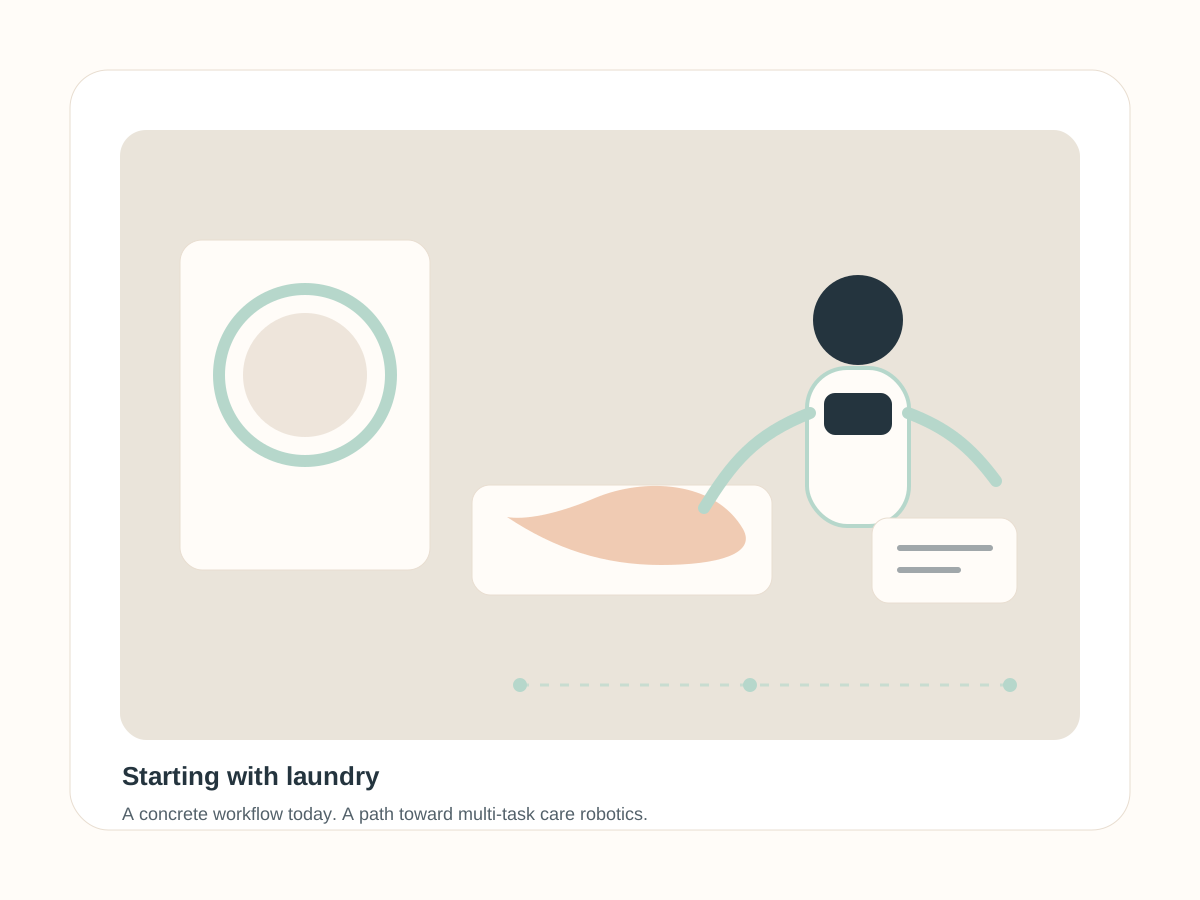
Starting with laundry
Laundry is repetitive, physical, and operationally measurable. It is a useful starting point because success depends on more than folding: the robot must understand the workflow from one handoff to the next.
Receive or pick up laundry at defined workflow points.
Manipulate deformable items at realistic speed and with recoverable failure modes.
Maintain item identity and route clean laundry to the correct destination.
Move through the facility while respecting people, shared spaces, and operating rules.
Complete the handoff and record workflow state for staff visibility.
Safety & human oversight
Tasks, spaces, permissions, and prohibited actions are agreed before deployment.
Exceptions can be escalated rather than forcing the robot to improvise beyond its confidence.
Sensing and data use are designed around the minimum needed for each operating task.
Pilot process
A pilot should be lightweight for the facility and specific enough to produce an operational decision.
Observe the real workflow, space, staffing, and exceptions.
Choose the task boundary, operating hours, and success criteria.
Run the robot in the actual operating environment with human oversight.
Track labor impact, intervention rate, completion, and workflow fit.
Expand only where the operational case is repeatable.
FAQ
No. We present current, in-development, and future capabilities separately. Our approach is to deploy bounded workflows with human oversight and increase autonomy as reliability is proven.
The intent is to fit existing operations wherever possible. A pilot begins with a site and workflow review so physical constraints are understood before deployment.
Operating boundaries, facility permissions, supervised rollout, intervention paths, and task-specific sensing are treated as part of the product rather than an afterthought.
A repeated workflow with measurable labor, a clear start and end state, manageable environmental variation, and an operator willing to review the workflow with us.
Explore a pilot
We work with care operators in the U.S. and Japan to identify tasks where Physical AI can create measurable capacity without adding unnecessary operational burden.